

Mission Statement
Architecture reflects life: a relational stage where meaning unfolds. Planetary design calls for poetic minds with technical rigor to shape human and ecological futures.
Biography
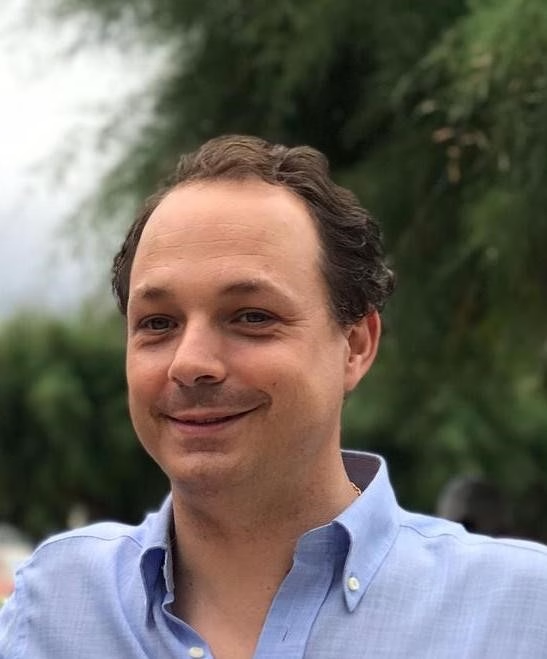
Juan Roquette is an architect and Full Professor at the School of Architecture of the University of Navarra, where he teaches theory of form, geometry, scenography and creative processes in architecture and design. Architect (2002) and PhD (2010), he received the Royal Academy of Doctors of Spain Award for his doctoral research. His academic career includes periods as Visiting Scholar at Panama University, Zhejiang University (China) and Nicolaus Copernicus University (Poland). He has also practised professionally for over fifteen years, completing several built projects and contributing to award-winning works and publications in collaboration with fellow architects.
Roquette’s work is characterised by an interdisciplinary approach that brings together architectural design, critical thinking, sustainability, digital fabrication and the creative arts. He is particularly interested in scenography and in the design of everyday space from a human-centred perspective. He participates in several research projects on sustainable innovation, pedagogical experimentation, scientific culture and the role of representation in architectural knowledge. Alongside his academic activity, he has a solid background in music and a sustained interest in the intersection between artistic practice, spatial experience and human wellbeing.
Committed to design as a transformative tool, he collaborates with institutions and international networks to explore new models that integrate creativity, technology and environmental responsibility.
Questionnaire
Where do you want to foster change and why?
I seek an architecture that shapes life as a received gift, uniting form and energy to heal our bond with the world and those who inhabit it.
What or who influenced you during your professional career?
Studying music and playing the piano have shaped me deeply; they taught me more about life, rhythm and meaning than any architectural subject.
We all have those significant moments or situations (success or failure); which one was yours, and what did you learn from it?
Simultaneously managing the UN headquarters project in Latin America, launching a new office and teaching at the university taught me that working without a boss is demanding: you become your own. The busier you are, the more—and the more interesting—you achieve.