

The Shift in Design Policy
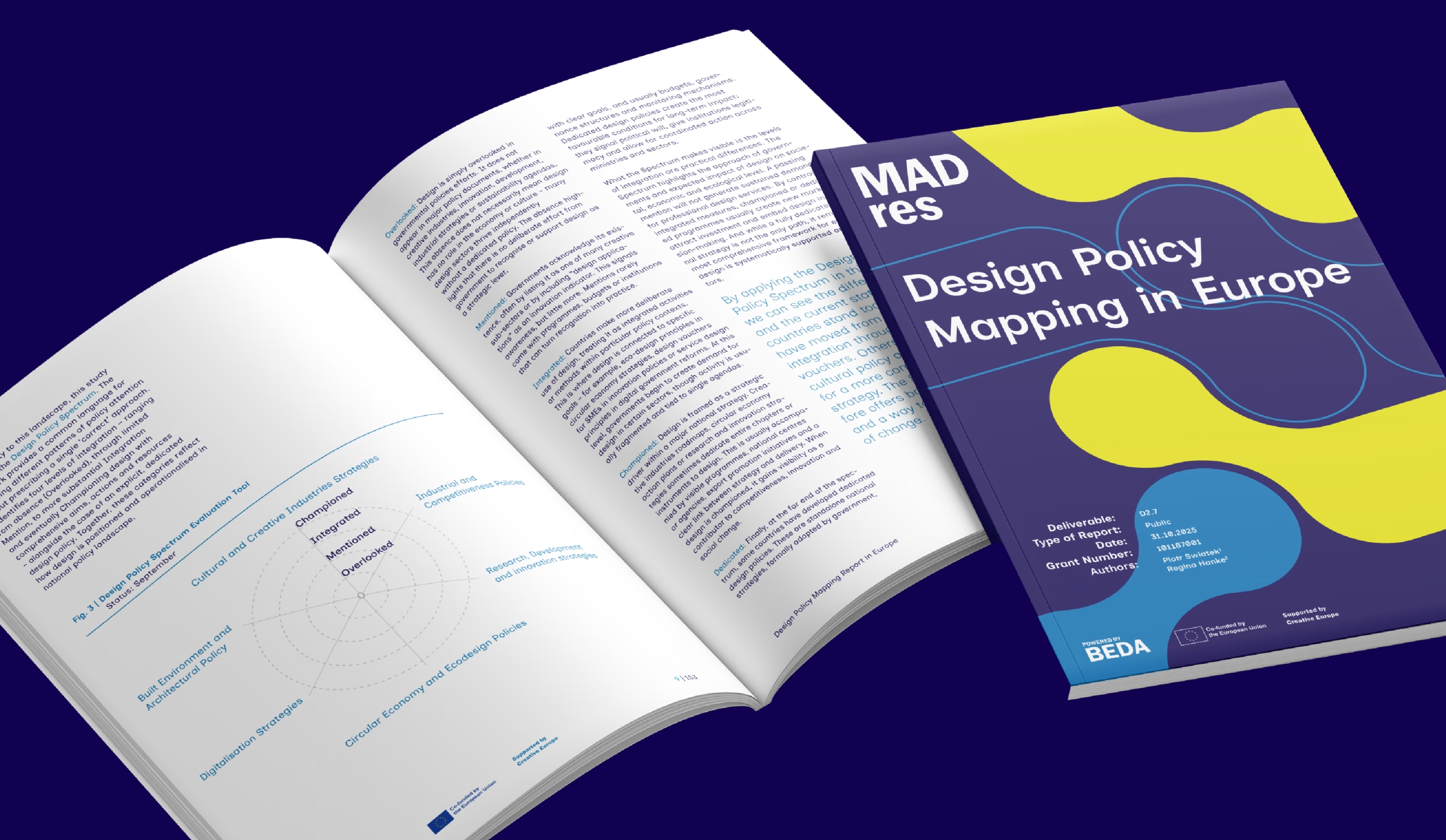
Building on BEDA’s earlier European Design Report 2.0 (2018), the study provides an up-to-date overview of governments’ approaches to design and highlights how design is embedded in national strategies spanning from cultural and creative industries, research and development, industrial competitiveness, circular economy, digitalisation to built environment.
The findings highlight strong integration in eco-design policies, driven by EU regulations, and frequent inclusion in creative strategies. However, design remains scarcely embedded in digital strategies, research and development, architecture, and the built environment, signalling a critical gap that needs attention.
Five key findings support the need for a revised approach to design policy:
- Only two dedicated design policies remain in Europe – Latvia and Iceland.
- Design is more present than ever, integrated across multiple policy domains.
- From explicit to embedded – design has shifted from stand-alone strategies to cross-cutting policy roles.
- Different policy families, distinct roles – design acts as a creative industry, an innovation method, a sustainability lever, and a tool for user-centred public services.
- Dedicated policies can provide coherence, if they are firmly integrated in the governmental arena – where they exist, they can have the potential to connect agendas and strengthen visibility; where they do not, the design’s role might be more fragmented and harder to sustain.
A Changing Landscape
The results of the study reveal a striking paradox:
“On the one hand, explicit design policies are rare. On the other hand, design is more visible and influential than ever.“
– Piotr Swiatek, Project Manager and Researcher in Design and Innovation Policy Team at PDR, BEDA Treasurer
Only Latvia and Iceland currently maintain dedicated national design policies, compared to more than a dozen in the 2010s. Nevertheless, design has become increasingly embedded across related policy families, shaping approaches to innovation, industrial development, sustainability, and public-sector transformation.
Regina Hanke, Project Lead at MADres, emphasises:
“The study has shown that in the current complex social, economic, and political environment, dedicated design policies are replaced by targeted strategic integration of design in related policies. Yet, independent of whether there is a dedicated design policy or a design integration in policies – both approaches need an overarching mindset and must rest on many shoulders within governmental processes to create the intended benefits.”
The Challenge for Design Policy
The report highlights a critical challenge: Europe’s design policy landscape remains fragmented.
Across the continent, numerous national and regional initiatives recognise design as a strategic factor for innovation and sustainable growth, yet few have developed into unified national frameworks. While design is in some countries acknowledged as a strategic enabler in innovation, culture, sustainability, and public-sector reform, these efforts are often dispersed across multiple ministries, sectors, and programmes.
This fragmentation limits continuity, coordination, and visibility. Without a coherent policy framework or mindset, Europe risks underutilising one of its most powerful tools for driving innovation and sustainable transformation.
To unlock the design’s full potential, the report calls for more integrated policy approaches that link cultural, economic, and sustainability objectives, transforming widespread recognition into lasting structural support.